
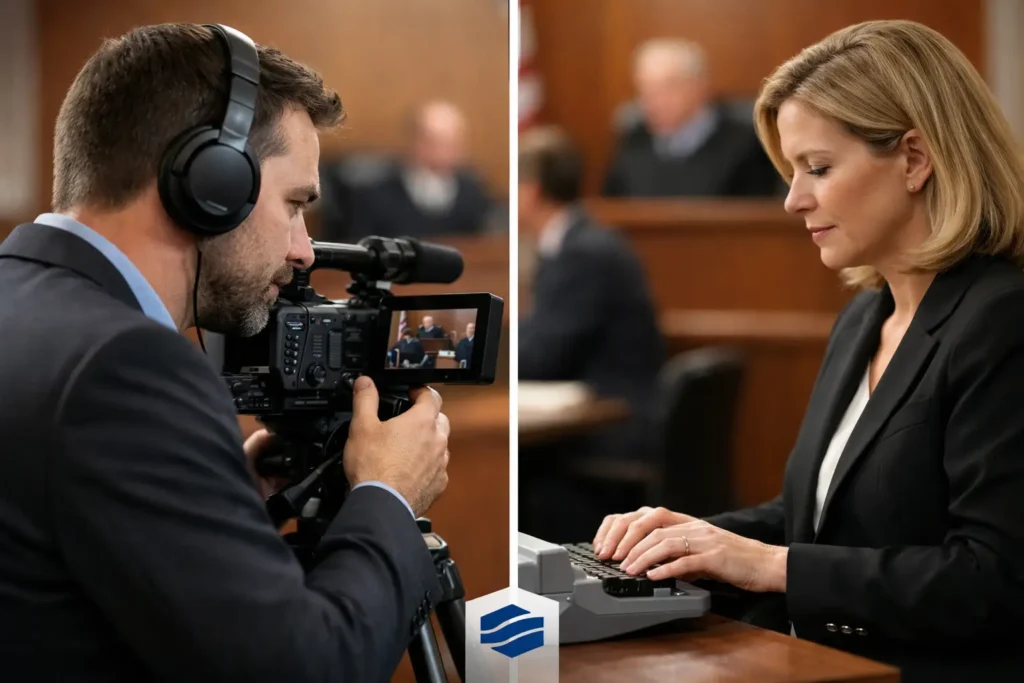
A legal videographer vs court reporter comparison is not a choice between two interchangeable deposition vendors. Each professional creates a different record, serves a distinct procedural function, and contributes to how testimony is preserved, reviewed, and presented later. For Seattle-area legal teams managing complex testimony, understanding the difference helps prevent avoidable gaps in deposition planning.
A court reporter produces the official written transcript. A legal videographer records the witness, attorneys, exhibits, and spoken testimony in a format that can be reviewed and used visually. In many matters, the strongest approach is not choosing one over the other. It is coordinating both services from the start.
Legal Videographer vs Court Reporter: The Core Difference
The court reporter captures the spoken record and prepares a verbatim transcript. That transcript is central to deposition review, motion practice, impeachment preparation, and many other litigation tasks. Reporters also manage the formal transcript process, including readback, certification, and other requirements that may apply under the governing rules and the parties’ arrangements.
The legal videographer creates the audiovisual record. A professionally produced deposition video captures more than words. It preserves the witness’s pace, pauses, tone, demeanor, and nonverbal reactions that a written page cannot fully convey. The videographer also manages the technical side of the proceeding: camera framing, audio quality, recording continuity, exhibit visibility when appropriate, and reliable media delivery.
Neither record diminishes the value of the other. The transcript is searchable, quotable, and indispensable for detailed legal analysis. Video gives attorneys a direct way to revisit how testimony was delivered and, when permitted and useful, present that testimony effectively at mediation or trial.
What a Court Reporter Does During a Deposition
Court reporters are responsible for creating an accurate stenographic record of what is said on the record. Their work demands close attention to testimony, objections, clarifications, spellings, and the identification of speakers. Afterward, the reporter prepares the transcript that attorneys use to analyze testimony and support case strategy.
For counsel, the transcript offers practical advantages every day. It allows a legal team to search key terms, isolate admissions, cite page and line references, compare testimony across witnesses, and prepare outlines efficiently. When a witness gives a lengthy or technical answer, the transcript remains the working document for precise review.
A court reporter’s role can also include administering the oath, depending on the setting and applicable procedures. Because deposition requirements can vary by jurisdiction, case type, and stipulation, counsel should confirm the necessary arrangements before the deposition date rather than assume one service provider is handling every procedural requirement.
What a Legal Videographer Adds to the Record
A legal videographer records deposition testimony according to established legal video practices and delivers media designed for litigation use. The work is not simply placing a camera in the room. Legal video requires careful attention to sound, lighting, witness composition, timestamps, record announcements, and the conditions that support a dependable courtroom-ready product.
The value becomes clear when the witness’s delivery matters. A transcript may show the words “I do not remember.” Video can show whether that answer came after a long pause, with certainty, hesitation, frustration, or visible confusion. Those details do not decide a case by themselves, but they can materially affect how attorneys assess credibility, prepare negotiations, and communicate testimony to a judge, jury, mediator, or client.
Legal video is especially useful when there is a meaningful possibility that a witness will be unavailable for trial, when expert testimony is difficult to translate from the page, or when counsel wants a clear record of a pivotal witness. It can also help trial teams avoid reading extensive deposition designations aloud when video testimony is authorized for use.
Why Many Depositions Need Both Services
For most video-recorded depositions, the transcript and video should work together. The transcript provides precision. Video provides context. When paired with transcript synchronization, counsel can move directly from a word or phrase in the transcript to the corresponding moment in the recording.
This is valuable during fast-moving trial preparation. Instead of manually locating a passage in a long video file, attorneys and support staff can identify a page-and-line citation, review the synced clip, and determine whether it is suitable for a designation or demonstrative presentation. That efficiency matters when deposition designations, objections, and edited playback materials must be completed on a court-driven schedule.
A synchronized video can also improve internal case review. Partners, associates, paralegals, experts, and clients can evaluate key testimony without sitting through hours of footage or relying only on a written excerpt. The objective is not to replace close transcript analysis. It is to give the legal team a more complete way to evaluate the record.
Remote and Hybrid Depositions Require Clear Roles
Remote proceedings have made the distinction between these services even more important. In a Zoom deposition, the court reporter still needs a clear, intelligible spoken record. The legal videographer is responsible for capturing the proceeding in a reliable video format and managing the recording process in a way that supports the legal team’s intended use.
A platform-generated recording is not automatically a substitute for professionally managed legal video. Audio can be inconsistent, participant windows may shift, internet interruptions can affect continuity, and the resulting file may not be organized for transcript synchronization or later courtroom playback. The right setup depends on the matter, the witness location, the anticipated use of testimony, and any agreements among counsel.
Hybrid depositions add another layer of coordination. Some participants may be in a conference room while others appear remotely. A professional legal video team can plan camera placement, audio routing, platform recording, witness views, and backup measures before testimony begins. That preparation protects the record and reduces technical distractions for counsel.
When Video Is Worth Adding
Not every deposition demands video. If testimony is brief, largely administrative, and unlikely to be used beyond routine discovery, a transcript alone may be sufficient. The decision should be tied to the case strategy, not made by habit.
Video is often worth considering when the case involves a key fact witness, a treating provider, a damages witness, a difficult expert concept, or testimony likely to be used in mediation or trial. It may also be useful when witness demeanor is expected to be significant, travel or availability creates uncertainty, or the legal team anticipates needing concise clips for presentation.
Counsel should make that decision early. Late requests can create avoidable complications with notices, scheduling, witness coordination, remote platform arrangements, and the time needed for synchronization or editing. A short planning conversation before the deposition can clarify whether the team needs a basic video record, synchronized video, designated clips, or more extensive trial presentation support.
Planning for a Usable Litigation Record
The best results begin with clear expectations. Confirm whether the deposition will be in person, remote, or hybrid; identify all locations and expected participants; determine whether exhibits must be shown on camera; and discuss the intended deliverables before the proceeding. If expedited turnaround or trial editing may be needed, communicate that timeline at the outset.
It is also helpful to distinguish between recording the deposition and creating a presentation-ready product. Raw or standard deposition video preserves the event. Trial-ready clips may require designation review, editing to the agreed excerpts, transcript synchronization, and formatting for courtroom playback. Those are related services, but they are not the same task.
At Royal Video Productions, experienced legal video support is built around that distinction. The goal is to give attorneys a dependable visual record and responsive production support without adding another layer of coordination to an already demanding case schedule.
A court reporter gives your team the words. A legal videographer preserves how those words were delivered. When the testimony matters enough to revisit, evaluate, or present, planning for both records can give your case team more options when the deadline arrives.