
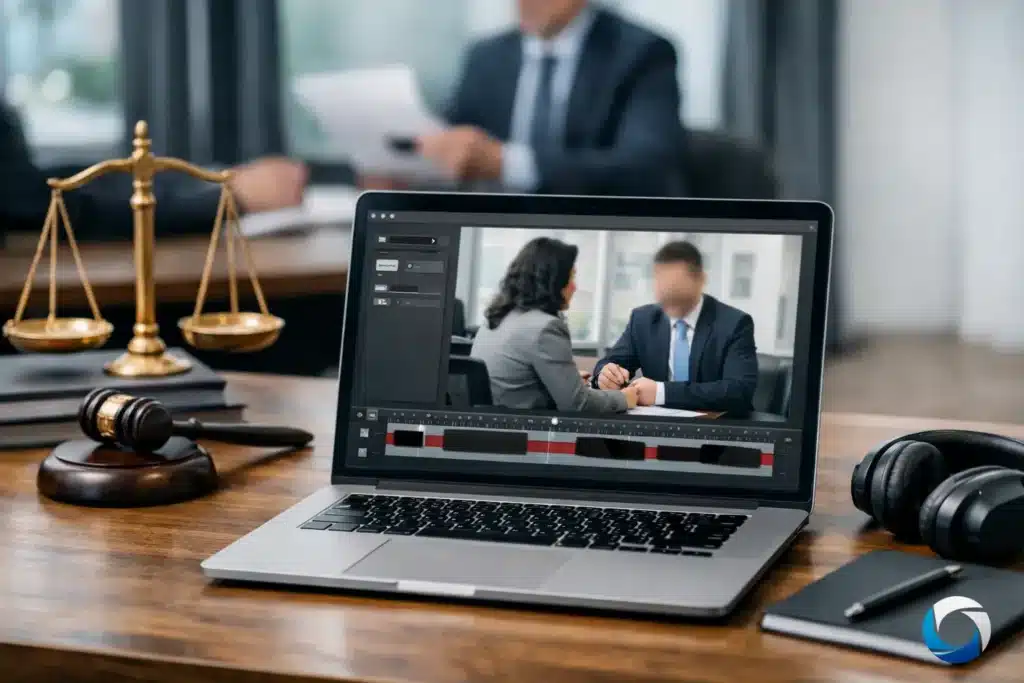
A witness says a phone number aloud during a recorded deposition. A medical chart appears on screen for three seconds. A child walks through the background of a day-in-the-life video. Each moment may be brief, but each can create a serious disclosure issue if the file is shared, filed, played in mediation, or presented at trial. This guide to video file redaction explains how legal teams can identify sensitive material, remove it reliably, and preserve a clean record of the work performed.
Video redaction is not simply placing a blur over an image. It is a controlled post-production process that must account for visual content, spoken information, captions, synchronized transcripts, metadata, and the specific version of the file being used as an exhibit. The right approach depends on the court order, protective order, applicable privacy obligations, and the intended use of the video.
What Video File Redaction Means in Litigation
Video file redaction is the permanent removal or concealment of protected, confidential, irrelevant, or otherwise restricted content within a video asset. In legal matters, the goal is usually twofold: prevent unauthorized disclosure while retaining a usable, accurate, courtroom-ready recording.
A redaction may involve a black box, pixelation, blur, a cropped frame, muted audio, an audio bleep, or removal of an entire segment. The method should fit the material. A name displayed in a document may be covered with an opaque mask. A spoken Social Security number requires audio redaction. If the sensitive information appears in both picture and sound, both tracks must be addressed.
The original source file should remain preserved and access-controlled. The redacted version is a separate derivative file, clearly labeled so there is no confusion about which version may be distributed or presented. A legal team should never assume that an edited copy replaces the original evidentiary record.
Start With a Redaction Plan Before Editing
The most costly mistakes happen before an editor opens the file. Legal teams should define what must be redacted, why it must be redacted, and who has authority to make the decision. An editor can execute instructions precisely, but counsel and the client are generally best positioned to determine what information is protected, privileged, subject to an order, or strategically inappropriate for release.
A practical plan identifies the source recording, exhibit number or production designation, intended audience, deadlines, and required delivery format. It should also state whether the redactions apply only to a public-facing copy or to every circulated version. A clip prepared for a settlement presentation may have different requirements than a clip intended for court filing.
Time-coded instructions are essential. Rather than writing “remove patient name near the middle,” identify the exact range, such as 00:17:42:08 through 00:17:46:12, and describe the item to be concealed. Frame-accurate timecode matters when a disclosure appears for only a few frames or when a witness starts saying a number before the editor can react to the visual cue.
When a synchronized transcript is involved, mark the corresponding transcript pages and lines as well. A video may be properly redacted while the synchronized transcript still displays the same private information during playback. The final deliverable must be reviewed as the end user will experience it.
Common Material That May Require Redaction
Sensitive content varies by case, but legal video teams frequently encounter personal identifiers, medical information, financial account details, addresses, email addresses, minor children, protected witnesses, license plates, and proprietary business information. Screenshots, phone screens, body-worn camera footage, and records displayed as exhibits can contain more information than the speaker discusses.
Do not overlook incidental disclosures. A name may appear in a computer notification, an office badge, a reflection in a window, a background document, or a file path visible on a monitor. Audio can reveal information outside the primary testimony, including side conversations, hallway remarks, or an off-camera person stating identifying details.
Choose a Redaction Method That Cannot Be Reversed
The central technical question is whether the redaction is actually permanent. A visual overlay that appears only in a presentation application is not enough if the underlying image remains accessible in the delivered media. Likewise, simply trimming a clip in a non-destructive project may leave the omitted footage available to anyone who receives the original file or project data.
For visual information, an opaque box is generally the clearest and least ambiguous method. Pixelation and blur can work in some circumstances, but they carry risk when the original image is high resolution or when a face, document, or plate remains recognizable through the effect. If the information must be concealed, the safer choice is usually a solid mask that fully covers it throughout the relevant frames.
For audio, muting is appropriate when the surrounding context is not needed. A tone or bleep may preserve timing and make it clear that an intentional redaction occurred. Re-recording or substituting audio requires additional care because it can alter the perceived meaning of the testimony. If context matters, use the least intrusive technique that fully protects the restricted content.
Redactions must also track moving objects. A static box placed over a face is ineffective when the subject turns, walks, or the camera pans. Motion tracking and frame-by-frame review are often necessary, especially with surveillance footage, accident-scene video, and handheld recordings.
Preserve the Original and Document the Work
A defensible workflow treats the original recording and the redacted copy as distinct evidence assets. Preserve the original in its received form, along with any available source information, delivery history, and identifying file details. Create the redacted version from a verified working copy rather than editing the only available source.
Use clear file names that distinguish the original, working, review, and final redacted versions. A naming convention might include the matter identifier, source designation, date, version number, and a clear “REDACTED” label. Avoid vague labels such as “final final” or “new edit,” which invite confusion under deadline pressure.
Keep a redaction log. It does not need to be elaborate, but it should identify the file, the date of work, the editor or production team, the timecode ranges, the redaction type, and the instruction or authority supporting the change. This record helps counsel answer questions about what was removed and confirms that the deliverable was deliberately prepared rather than accidentally altered.
Where the matter requires a more formal chain of custody, coordinate the production process with the firm’s evidence-handling protocol. The needed documentation depends on the case, the source of the video, and whether authenticity or completeness may be contested.
Review the Delivered File, Not Just the Edit Timeline
Quality control is where a redaction becomes reliable. The reviewer should watch the rendered file from beginning to end, with particular attention to every redaction boundary. Start points, end points, fades, cuts, and camera movement are common places for a partial disclosure to slip through.
Review the file at normal speed and inspect sensitive moments frame by frame. Listen with headphones, especially when the recording contains low-volume speech, overlapping voices, or audio that continues across a visual cut. Confirm that captions, burned-in subtitles, exhibit callouts, and synchronized transcript text do not repeat the protected information.
Technical review should also include the actual delivery environment. A redacted MP4 may be acceptable for secure review, while a courtroom playback system, deposition platform, or filing requirement may call for a different format. Test the file on the intended playback method before the deadline. A correct redaction is of little help if the file will not play, loses synchronization, or displays differently in the courtroom.
Avoid Shortcuts That Create Disclosure Risk
Several shortcuts regularly create problems. Sending an editor a vague instruction without timecode can produce an incomplete redaction. Delivering a screenshot of a masked frame instead of a properly rendered video can leave the source clip untouched. Redacting only the video while overlooking audio, captions, or transcript synchronization can disclose the same information through another channel.
Another common error is circulating review copies too broadly. Until final approval, treat working files and review exports as sensitive. Limit access, use the approved transfer process, and make sure recipients understand whether they are receiving an original, a preliminary redacted draft, or the final authorized version.
Do not assume that a redaction decision is permanent across every purpose. If an order changes, a witness designation is modified, or a demonstrative is revised, the legal team may need a newly redacted version. Version control prevents an earlier file from being used by mistake.
When Specialized Legal Video Support Helps
Routine edits can become complex quickly when a matter involves multiple deposition clips, synchronized transcripts, extensive exhibit footage, or a court deadline. A legal video specialist understands that timing, exhibit integrity, transcript alignment, and playback reliability are part of the assignment, not afterthoughts.
For Seattle-area legal teams, Royal Video Productions brings category-specific experience to redaction and litigation video preparation, with a process built around clear instructions, careful review, and deadline-driven delivery. The strongest result comes when counsel identifies the legal scope of the redactions and the production team applies that direction with frame-level precision.
Before any redacted file leaves your office, ask one final question: if this recording is played on a large screen, heard through courtroom speakers, and reviewed alongside its transcript, is every restricted detail still protected? That final review is often the most valuable step in the entire process.