
A witness may be in Seattle, counsel may be in another state, and a key exhibit may require careful handling in real time. That is where the choice between hybrid deposition vs remote deposition becomes more than a scheduling preference. The format affects who can participate, how exhibits are managed, how the record is preserved, and how much coordination the legal team must carry before the notice is ever sent.
Both formats can support effective discovery. Neither is automatically better. The right choice depends on the witness, the subject matter, the number of participants, the expected use of testimony, and the level of technical control the matter requires.
Hybrid Deposition vs Remote Deposition: The Core Difference
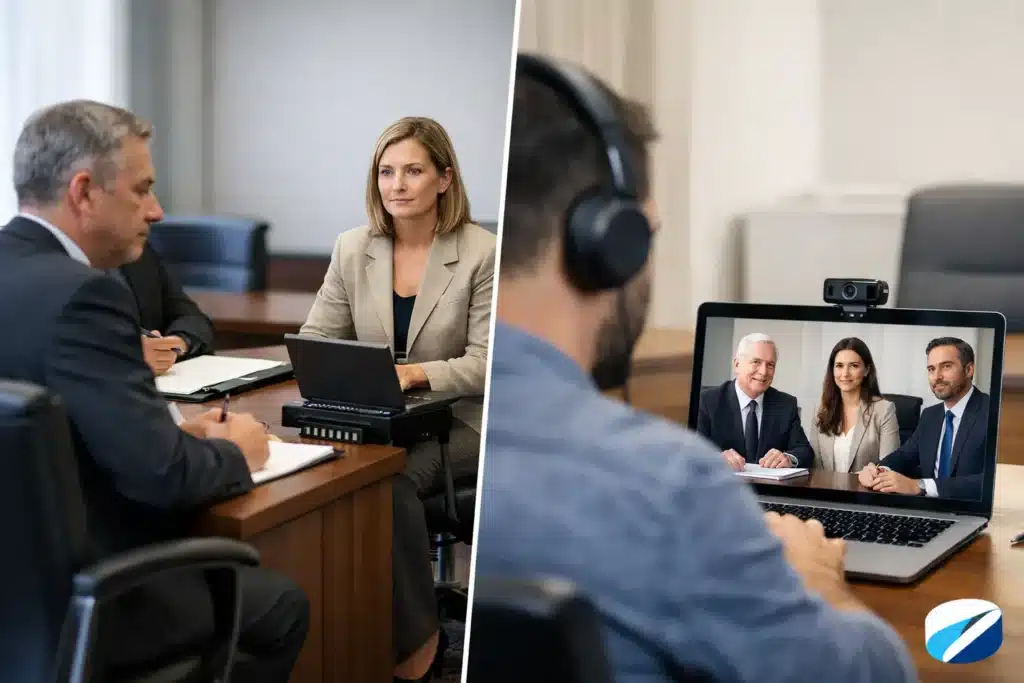
A remote deposition is conducted with participants appearing through a videoconference platform from separate locations. The witness, attorneys, court reporter, videographer, interpreter, and other attendees may all join remotely. It is often the most efficient option when travel is impractical or when the testimony is straightforward enough to be handled through a well-managed virtual session.
A hybrid deposition combines an in-person setting with remote participation. For example, the witness, court reporter, and legal videographer may be together in a conference room while one or more attorneys attend by videoconference. In another arrangement, lead counsel may be in the room with the witness while co-counsel, experts, or parties observe remotely.
The distinction matters because an in-person production team can control the witness environment, camera framing, audio capture, lighting, exhibit display, and contingency planning. Remote attendees still receive the access they need, but the central portion of the proceeding is professionally managed from a controlled location.
When a Fully Remote Deposition Makes Sense
Remote depositions are particularly useful when geography is the primary obstacle. A short fact-witness examination, a cooperative witness, or a deposition involving attorneys and parties in multiple jurisdictions may not justify bringing everyone to one location. When the anticipated testimony is primarily verbal and exhibits are limited, remote participation can reduce logistical friction without compromising preparation.
This format also works well for preliminary testimony where counsel needs information quickly. A properly scheduled remote deposition allows the team to obtain testimony while maintaining momentum in discovery, especially when witness availability is narrow.
The practical requirement is preparation. Participants need reliable internet connections, a quiet and private setting, functional cameras and microphones, and a clear understanding of how exhibits will be introduced. The videographer and court reporter should know in advance whether interpretation, screen sharing, document marking, breakout rooms, or a synchronized transcript will be required.
A remote deposition becomes less attractive when any participant is likely to have poor connectivity, when the witness environment cannot be controlled, or when a substantial volume of physical evidence will be examined. A weak connection may be a temporary inconvenience in a casual meeting. In a deposition, it can interrupt questioning, obscure a response, complicate objections, and create uncertainty about what the witness was shown.
Why Legal Teams Choose a Hybrid Format
A hybrid format gives legal teams flexibility without surrendering control over the most consequential elements of the record. It is often the better fit when the witness is local, the subject matter is complex, or counsel expects the video to have future value in mediation, motion practice, or trial preparation.
With the witness in a professionally managed room, the legal video team can capture consistent image and audio quality. The witness is framed appropriately, microphones are monitored, and the lighting remains stable throughout the examination. Remote participants can see and hear the proceeding clearly while the in-room team manages the production details that are difficult to control from a distance.
Hybrid proceedings can also reduce the pressure on lead counsel. Rather than troubleshooting an audio setting or asking a witness to reposition a laptop camera, counsel can remain focused on examination. That division of responsibility is especially valuable in contentious liability matters, expert testimony, or depositions involving medical records, diagrams, photographs, and other exhibits that require close attention.
For Pacific Northwest cases involving out-of-area counsel, hybrid depositions can be a practical middle ground. Local witnesses can appear in a controlled environment while attorneys, insurers, experts, or clients attend remotely. The arrangement preserves access without requiring every participant to travel.
Exhibit Control Is Often the Deciding Factor
Exhibits are one of the clearest reasons to consider hybrid rather than fully remote testimony. A remote deposition can handle digital exhibits effectively when documents are organized, premarked when appropriate, and distributed through an agreed process. Counsel must still account for screen-sharing delays, visibility on different devices, and the possibility that a witness is viewing only a portion of the page.
In a hybrid setting, physical and digital exhibits can be managed with greater consistency. The witness can receive a document in the room, counsel can direct attention to a specific page or image, and the production team can coordinate the presentation for remote attendees. This does not eliminate the need for a clear exhibit protocol, but it reduces avoidable confusion.
The greater the exhibit burden, the more valuable that control becomes. Consider a deposition involving construction photographs, medical imaging, technical drawings, product components, or a detailed timeline. If the witness must compare multiple documents, annotate material, or examine a physical item, an in-person witness setup can protect the pace and clarity of the examination.
Before selecting a format, counsel should ask whether the witness needs to handle anything other than a standard document. If the answer is yes, hybrid may be the more reliable choice.
Record Quality and Future Use of Testimony
A deposition is not just a live event. It may later become a clipped video designation, a synchronized transcript, a mediation presentation, or an evidentiary component of trial preparation. The desired future use should influence the format decision at the outset.
Remote video can be clear and usable when every participant has strong equipment and stable connectivity. However, a remote record may reflect uneven camera angles, variable lighting, compressed video, background distractions, or inconsistent sound. These issues do not necessarily make testimony unusable, but they can reduce its effectiveness when a decisive segment must be replayed months later.
Hybrid depositions generally provide a more consistent visual record because the witness is captured with professional equipment in a controlled environment. That consistency matters when credibility, demeanor, injury impact, or technical explanations are likely to be important. It also gives the legal team a stronger starting point if footage later needs editing, synchronization, or courtroom playback preparation.
The question is not whether remote video is acceptable. The question is whether acceptable is sufficient for the testimony at hand. For a routine witness with limited expected use, it may be. For a central witness whose video may be shown to a mediator, judge, or jury, a hybrid setup may better protect the value of the testimony.
Plan the Format Before the Deposition Notice Goes Out
The best results come from deciding the production approach early. Once the format is selected, the legal team can align the notice, witness instructions, conference-room needs, remote access details, exhibit process, and staffing around one clear plan.
For a remote deposition, confirm each critical participant’s location, bandwidth, camera, microphone, and backup contact method. Establish who will host the session, who will admit participants, how private attorney-client communications will be handled, and what happens if the witness disconnects during questioning.
For a hybrid deposition, identify who will be in the room and who will attend remotely. Confirm sightlines, remote audio feeds, document display needs, room access, and whether the witness will need breaks, interpretation, or special accommodations. If the matter involves a large exhibit set or demonstrative material, schedule enough lead time for the production plan to be tested.
A legal video professional should be involved before the deposition date whenever the setup has meaningful technical or evidentiary complexity. Early coordination helps prevent last-minute decisions that force counsel to choose between a delayed start and a less controlled record.
Choose Control When the Stakes Require It
The choice between hybrid and remote deposition formats should follow the demands of the testimony, not simply the convenience of the calendar. A fully remote session can be efficient and effective when the witness, technology, and exhibit load are manageable. A hybrid session is often the stronger option when counsel needs professional control of the witness environment while preserving remote access for a distributed team.
For legal teams preparing consequential testimony, a short production conversation can prevent hours of avoidable disruption. Royal Video Productions helps attorneys plan video depositions around the practical realities of witness logistics, exhibit handling, and courtroom-ready record quality – so counsel can direct their attention where it belongs: on the testimony.