
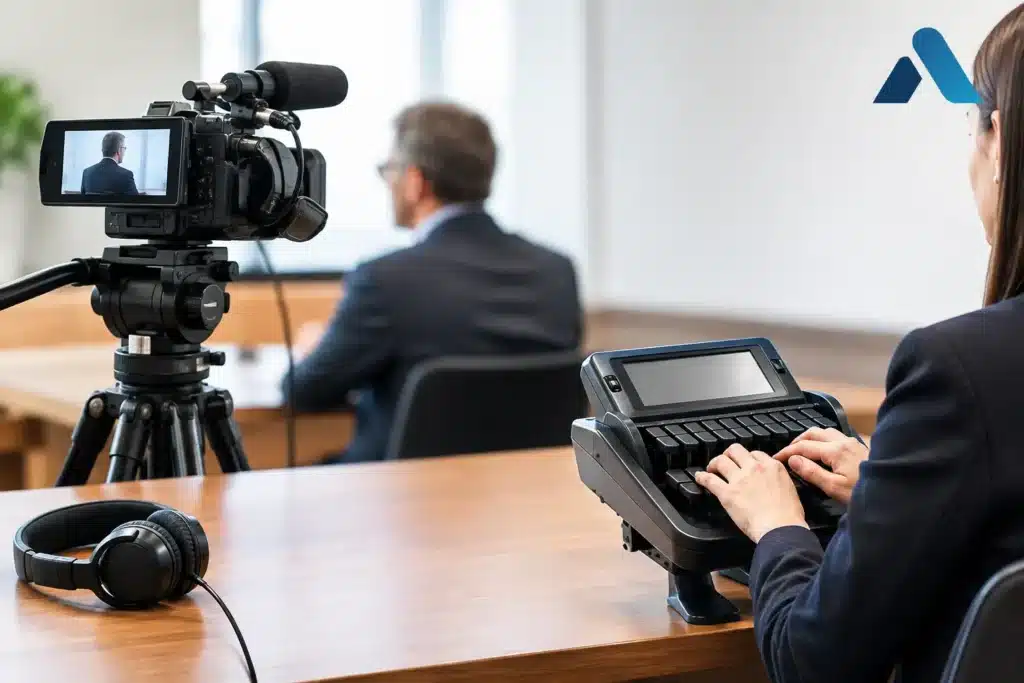
A witness may give the same testimony whether a camera is present or not, but the record available to counsel later can be very different. Deposition recording versus stenography is not simply a choice between two vendors or formats. It affects how a team evaluates credibility, prepares impeachment, presents testimony at mediation or trial, and preserves a witness’s words when that witness may be unavailable later.
For many matters, the strongest approach is not video instead of a transcript. It is a properly noticed video deposition supported by an accurate stenographic record, with each element handled by professionals who understand litigation procedure and deadline-driven trial preparation.
What stenography preserves
Stenography creates the written deposition transcript that lawyers rely on for citations, motion practice, witness preparation, and designations. A court reporter captures the spoken testimony and prepares a verbatim written record, subject to the applicable rules and certification requirements. The transcript is searchable, quotable, and familiar to every participant in the litigation process.
That utility begins during the deposition itself. Counsel can refer to page and line testimony, read back an answer, and make objections into a clear record. Afterward, a transcript allows attorneys and paralegals to locate a key admission quickly, compare testimony with discovery responses, and prepare precise excerpts for briefing.
A written record also reduces ambiguity. If a witness says, “I do not recall,” the transcript establishes the exact words used. For legal arguments that turn on language, timing, or an admission, that precision is indispensable.
Still, a transcript records speech, not the full communication. It cannot show whether the witness paused for a lengthy period, looked repeatedly to counsel, used a demonstrative gesture, spoke over a question, or delivered an answer with visible uncertainty. Bracketed notations such as “[inaudible]” or “[witness nods]” identify some events, but they do not convey the event itself.
What deposition recording adds
Professional legal video recording preserves the witness’s presentation as well as the testimony. The camera captures facial expression, pace, body language, demonstrative movements, and the interaction in the room. Clean audio ensures that the testimony can be heard and reviewed without relying solely on a written rendition of the exchange.
That additional information can matter most when credibility is disputed. A calm, credible witness may be more persuasive on video than a cold transcript suggests. Conversely, evasiveness, hostility, hesitation, or a sharp change in demeanor may carry weight that is difficult to communicate through selected lines of text.
Video also gives the litigation team a more realistic way to assess the deposition after the fact. The attorney who attended may remember a witness’s demeanor, but other team members, insurers, experts, mediators, or co-counsel may not have been in the room. A properly produced recording lets them evaluate the testimony directly.
The value is especially clear where testimony could later be played for a jury. If a witness is unavailable, if testimony is designated for trial under the governing rules, or if the parties need excerpts for a hearing or mediation, video can make the testimony more immediate and understandable. It can also preserve physical demonstrations, injuries, exhibits, and reactions that a transcript describes only imperfectly.
Deposition recording versus stenography is usually not either-or
The most practical distinction is that stenography creates the written legal record, while video creates a visual and audible record of the event. In many cases, both serve separate purposes and should be coordinated from the outset.
A transcript remains central to daily litigation work. Attorneys need page-and-line citations, searchable text, deposition summaries, and efficient tools for comparing testimony. Video does not replace those functions. Watching hours of footage is not an efficient substitute for searching a transcript when counsel needs every answer relating to a particular document, conversation, or date.
At the same time, a transcript cannot replace the strategic value of seeing and hearing a witness. When a deposition may be used at trial, when credibility is likely to drive settlement discussions, or when a witness’s condition or availability is uncertain, video can protect options that may be difficult to recreate later.
The right question is therefore not, “Which format is better?” It is, “What must this testimony accomplish for the case?” A straightforward fact deposition that is unlikely to be played may need only a reliable written record. A key liability witness, treating physician, corporate representative, or damages witness may warrant video from the beginning.
When video is particularly useful
Certain circumstances make a video deposition more than a convenience. In personal injury matters, visible limitations, pain behavior, mobility issues, and the human impact of injuries may be relevant to how testimony is understood. In a day-in-the-life context, that visual component can be even more significant, though it is a distinct production with its own evidentiary and strategic considerations.
Video can also help when a witness is expected to be unavailable for trial because of distance, health, military service, or an unpredictable schedule. Taking a deposition on video does not automatically make every portion admissible at trial, and counsel must still follow procedural rules, preserve objections, and obtain necessary rulings. But it preserves a courtroom-ready asset if later use is allowed.
Remote and hybrid depositions create another reason to think ahead. A platform recording may be useful for reference, but it is not always the same as a professionally managed legal video record. Camera framing, audio isolation, exhibit handling, participant identification, backup recording, and file delivery all affect whether footage will be useful when a deadline arrives. A legal videographer manages the video function with the deposition’s eventual use in mind.
Production quality is part of the legal record
A video deposition is not merely a camera pointed at a witness. Poor audio can make a crucial answer hard to understand. Improper framing can lose a demonstrative gesture or leave the witness’s face unclear. Technical interruptions can break concentration and create avoidable disputes about what occurred.
Professional production provides consistent image and sound, clear identification of participants, secure handling of media, and deliverables suitable for counsel’s review and later presentation. It also supports coordination with the court reporter, counsel, remote participants, and the deposition venue so the process does not become another task for the legal team to manage.
For trial preparation, the next step is often transcript synchronization. Synchronized video connects the footage to the transcript so users can search text, move directly to the corresponding testimony, and create precise clips. This is where the combined value of stenography and video becomes especially apparent. Counsel can find an answer by keyword, review the witness’s delivery, and prepare a designated segment without manually locating the point in a lengthy recording.
Editing requires equal care. A trial clip may need to reflect designations, objections, rulings, and the court’s formatting requirements. The objective is not to make testimony look promotional. It is to produce an accurate, intelligible, courtroom-ready presentation that respects the record.
Decide before the notice goes out
The decision to record on video should be made early enough to ensure proper notice under the applicable rules and any governing case order. Counsel should consider the deposition’s likely role in the case, the witness’s importance, the possibility of trial use, and whether visual conduct or demonstrative testimony will matter.
It also helps to identify the expected format in advance. Is the deposition fully remote, in person, or hybrid? Will exhibits be shared electronically? Does the team anticipate synchronized video, edited trial clips, or expedited delivery for a mediation or hearing? Answering those operational questions early allows production support to be matched to the actual needs of the case.
For Seattle-area legal teams, Royal Video Productions provides specialized legal video support for in-person, Zoom, and hybrid depositions, with the attention to procedure and responsiveness that time-sensitive litigation demands.
The deposition is often the only opportunity to preserve a witness’s testimony in full. When the testimony may matter beyond a page-and-line citation, plan for the record you may need when the case reaches mediation, motion practice, or the courtroom.