
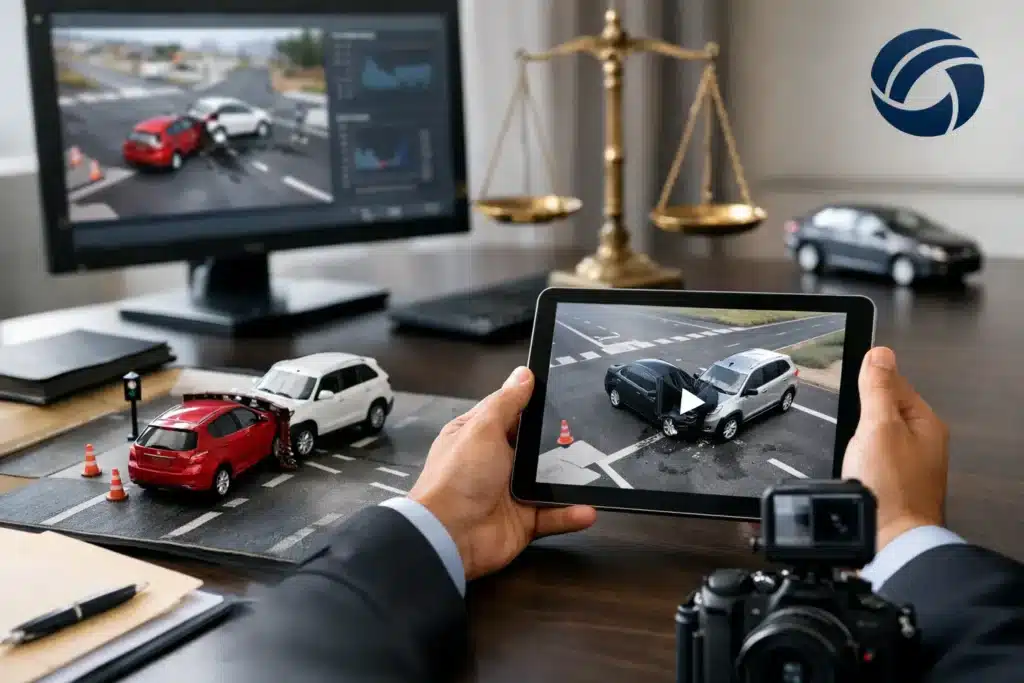
A strong accident reconstruction video guide begins before anyone opens an editing timeline. In a liability case, video can make the sequence of events understandable in seconds, but only when it faithfully reflects the evidence, the expert’s opinions, and the legal theory being presented. A polished animation with unsupported assumptions can create more risk than value.
For attorneys and litigation teams, the goal is not simply to make an accident look dramatic. It is to give mediators, jurors, and opposing counsel a clear visual framework for evaluating speed, sight lines, timing, vehicle movement, points of impact, and available reaction time. The best reconstruction videos are disciplined demonstratives: technically grounded, easy to follow, and built for the forum where they will be used.
Start With the Question the Video Must Answer
Accident reconstruction video is most effective when it is assigned a narrow job. A broad request to show what happened often produces a presentation that is visually busy and strategically unfocused. Instead, identify the factual question the demonstrative needs to clarify.
That question may concern whether a driver had sufficient time to perceive a hazard, whether an approaching vehicle was visible, where pedestrians were positioned, or how impact forces relate to vehicle damage and occupant movement. In a commercial vehicle matter, it may involve stopping distance, lane position, turning radius, or camera views from the cab. In a premises-related incident, it may involve lighting, walking paths, obstructions, and the sequence leading to a fall.
One video can address several related points, but each scene should earn its place. If a visual does not help the viewer understand a disputed fact or expert opinion, it may distract from the argument. A concise two-minute demonstrative can be more persuasive than a ten-minute production that tries to explain every detail in the file.
Build the Reconstruction From Verified Source Material
The quality of an animation is limited by the quality of the inputs behind it. Before production begins, counsel and the reconstruction expert should identify the materials that establish the scene and the event sequence. These can include police reports, photographs, measurements, total station or drone survey data, vehicle inspection records, event data recorder information, surveillance footage, witness testimony, roadway plans, medical records, and weather information.
Not every source carries the same weight. A witness estimate of speed may conflict with physical evidence. A surveillance camera may distort distance because of lens angle or frame rate. Post-incident photographs can show final rest positions but not necessarily the exact path each vehicle traveled. Those limitations do not prevent video use, but they should shape the expert’s analysis and the wording used within the demonstrative.
A reliable production workflow distinguishes among three things: documented facts, expert conclusions, and illustrative elements. Documented facts might include roadway dimensions, vehicle models, final positions, or recorded video frames. Expert conclusions may include calculated speed ranges, perception-response intervals, or collision dynamics. Illustrative elements include the visual styling, camera angle, labels, and pacing used to communicate those opinions.
That distinction matters because a video should not quietly turn an illustration into a fact. When an element is based on an assumption, range, or contested testimony, the production team should know how counsel and the expert want that uncertainty handled.
Preserve Versions and Approval Records
Reconstruction videos are often revised as discovery develops, experts refine opinions, or counsel adjusts a trial theme. Version control is essential. Each edit should be dated, identified, and traceable to the materials and expert direction used at that stage.
Maintain a clear approval process. The reconstruction expert should review technical accuracy, while counsel should review legal strategy, terminology, and consistency with the case record. A legal video production team can manage edits and deliverables, but it should not independently make substantive choices about speed, timing, visibility, or causation.
Choose the Right Visual Approach
Not every matter calls for a full 3D animation. The appropriate format depends on the evidence, the disputed issues, the available time, and the audience. A simple annotated video or a sequence of still exhibits may be more effective when the primary issue is a single sight-line or timing question.
A full reconstruction animation is generally most valuable when motion itself is central to the dispute. This includes complex intersections, multiple vehicles, changing traffic signals, pedestrian movement, roadway geometry, or events that are difficult to understand from static diagrams. It can also help an expert demonstrate alternate scenarios, provided each scenario is clearly identified and supported by the underlying analysis.
Camera perspective requires particular care. An overhead view can efficiently explain vehicle paths and distances. A driver-perspective view can help explain visibility, but it may be challenged if its camera height, field of view, lighting, speed, or obstruction placement does not reasonably reflect the evidence. Jurors can mistake a cinematic viewpoint for an exact re-creation, so clarity is often preferable to visual drama.
For mediation, a streamlined version may be appropriate. For trial, counsel may need a more deliberate presentation with exhibit numbers, synchronized expert narration, or the ability to pause on key frames. The video should be built around the intended use rather than repurposed at the last minute.
Make Timing and Scale Understandable
Time is frequently the hidden issue in collision cases. A driver traveling 44 feet per second covers significant distance during a brief glance away from the road or a normal perception-response interval. Video can make that concept understandable, but it must not overstate precision.
If the expert’s calculations provide a range, present a range. If the timing is estimated from available footage, avoid visual cues that imply frame-by-frame certainty where none exists. Labels, pauses, and restrained graphics can help the viewer see what matters without turning the production into an advocacy-heavy presentation.
Scale deserves the same attention. Vehicle dimensions, lane widths, grade, roadway curvature, trees, signage, parked vehicles, and lighting conditions can materially affect perception. Small errors in a scene model can have large persuasive consequences. The production should allow the expert to review these details at a practical level of zoom before final rendering.
Prepare for Admissibility and Courtroom Use
The evidentiary foundation for an accident reconstruction video depends on the jurisdiction, the purpose for which it is offered, the expert testimony supporting it, and the court’s rulings. Counsel should address those issues early, not after a final video has been rendered.
A demonstrative used to illustrate expert testimony may be treated differently from evidence offered as a substantive re-creation. The difference can affect disclosures, authentication, limiting instructions, and the degree to which opposing counsel will scrutinize every underlying assumption. When in doubt, plan for transparency. Keep the source materials, calculations, scene specifications, and expert approvals organized for review.
Courtroom readiness is also operational. Confirm the required file format, resolution, audio needs, playback system, and backup method. Create a clean version without embedded narration when the expert will testify live, as well as a version with narration when appropriate for mediation or settlement presentation. Test every file on the equipment that will actually be used.
For Seattle-area legal teams facing tight trial calendars, Royal Video Productions can coordinate courtroom-ready editing and playback deliverables while keeping the reconstruction expert and counsel in control of the substantive content.
A Production Checklist Before Final Approval
Before approving a final reconstruction video, confirm that the legal team, expert, and production team agree on the following:
- Every vehicle, roadway feature, and scene element is supported by a source or identified illustration.
- Speed, timing, distances, and visibility conditions match the expert’s final opinions.
- Labels, narration, and graphics use language consistent with pleadings, testimony, and case strategy.
- Alternate scenarios are clearly distinguished and not presented as established fact.
- The final files have been reviewed for technical playback, exhibit identification, and courtroom compatibility.
This review is not bureaucracy. It is the last opportunity to catch a misplaced vehicle, an outdated calculation, a misleading camera view, or a label that gives opposing counsel an unnecessary point of attack.
Keep the Video in Its Proper Role
An accident reconstruction video can make technical evidence accessible, memorable, and useful in decision-making. It cannot repair a weak factual record or substitute for a qualified expert’s analysis. Its credibility comes from the discipline behind it: verified inputs, clearly stated assumptions, purposeful design, and dependable presentation.
When the visual is built to explain rather than impress, it gives the fact finder something more valuable than spectacle: a clear path through the evidence.