
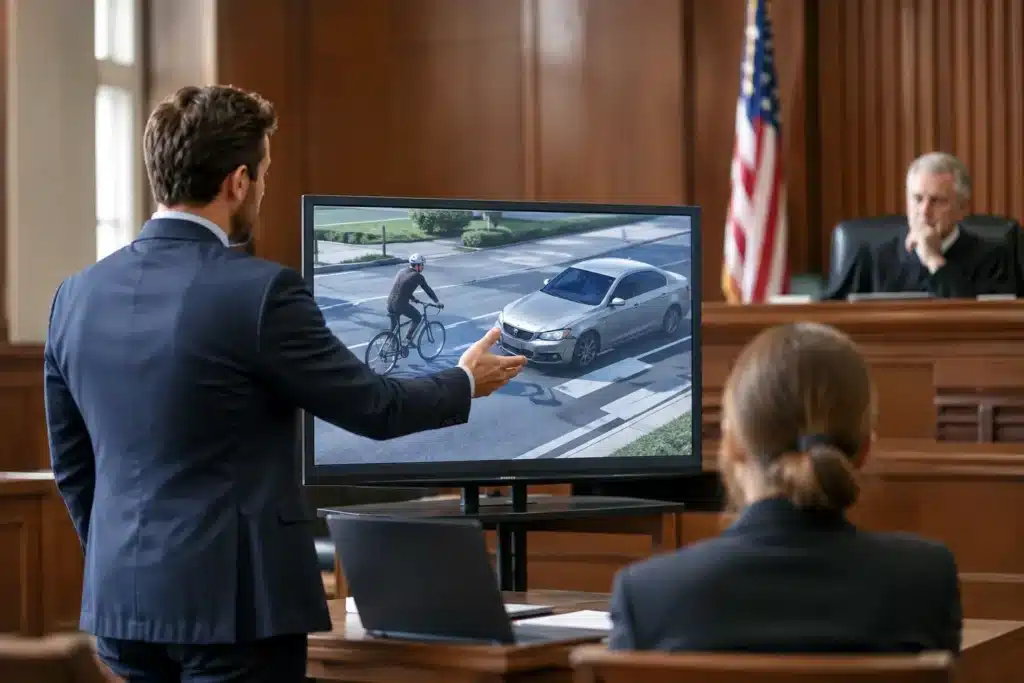
A strong courtroom animation example does not try to win a case with visual effects. It takes a sequence that is difficult to explain verbally – a vehicle movement, a line of sight, a workplace process, or a medical event – and presents it in a form jurors can follow. Its value comes from disciplined accuracy, a clear connection to the evidence, and timing that supports the attorney’s theory without overstating what the record can prove.
For trial teams, animation is often most useful when photographs, deposition testimony, diagrams, and expert opinions each tell part of the story but do not show how those parts fit together. The right demonstrative can organize that information into a coherent visual explanation. The wrong one can invite objections, confuse the jury, or make a credible case appear overstated.
A Courtroom Animation Example: Reconstructing an Intersection Collision
Consider a disputed intersection collision. The plaintiff contends that a commercial driver entered on a red light. The defense maintains that the passenger vehicle was speeding and entered after the signal changed. The available evidence includes traffic-camera footage, vehicle damage photographs, police measurements, electronic vehicle data, witness testimony, and accident reconstruction opinions.
A useful animation might begin with a neutral aerial view of the intersection. It identifies the lanes, traffic signals, crosswalks, and directions of travel. The scene then moves to a driver-level perspective only if that viewpoint is supported by measurements and evidence. Vehicles are shown at speeds and positions provided by the reconstruction expert, with the animation marking key points: signal phase, perception point, braking point, impact, and final rest positions.
The animation should make clear what it is illustrating. If it reflects one expert’s opinion, that relationship should be stated in the courtroom foundation and, when appropriate, within the presentation itself. It should not imply that it is actual video of the event. A clean label such as Demonstration Based on Reconstruction Analysis can help distinguish a forensic illustration from recorded footage.
This courtroom animation example works because it answers practical questions jurors may already have: Where could each driver see the other vehicle? How much time was available to react? What happened before impact? It does not need dramatic camera moves, sound effects, or cinematic editing. Those choices can distract from the evidence and give opposing counsel an opening to challenge fairness rather than substance.
What Makes an Animation Credible in Court
Credibility begins before production. The animation team needs a defined evidentiary basis, not an assumption-filled account of what probably happened. Depending on the matter, source materials may include survey data, scene photographs, video, discovery responses, expert reports, deposition excerpts, medical imaging, equipment records, or engineering drawings.
An attorney and retained expert must decide which facts are fixed, which are disputed, and which scenario the animation is intended to demonstrate. This distinction matters. An animation can fairly depict an expert-supported opinion, but it should not quietly fill evidentiary gaps with details that have no foundation.
The expert relationship matters
In many matters, the animation is a visual expression of an expert’s analysis. The expert should review the work at meaningful stages, not merely receive a completed video shortly before trial. Early review confirms dimensions, timing, sightlines, vehicle paths, body mechanics, machinery movement, or other technical components. A final review confirms that the completed animation accurately represents the opinion the expert will explain.
This process also protects trial counsel. If the animation includes a position, speed, angle, or timing sequence, the team should be able to identify the evidence or expert analysis supporting it. That preparation makes foundational testimony more direct and helps counsel respond when the court asks how the demonstrative was created.
Accuracy is more persuasive than drama
Jurors can sense when a demonstrative is trying too hard. Realistic textures, weather effects, and dramatic impact sequences may be appropriate in limited circumstances, but they are rarely the reason an animation succeeds. More often, persuasive force comes from accurate scale, uncluttered graphics, readable labels, and a pace that allows the jury to understand each event.
There is also a strategic trade-off. A highly detailed animation may feel compelling, but every extra detail can create another point to dispute. A simplified presentation can be more defensible when the case turns on only a few critical facts. The appropriate level of detail depends on the issues in dispute and the foundation available to support each visual element.
Build the Demonstrative Around the Question the Jury Must Answer
The most effective legal animations have a narrow purpose. They are not case summaries compressed into three minutes. They clarify one issue that is hard to understand through testimony alone.
In an intersection case, the central question may be whether the driver had sufficient sight distance to avoid the crash. In a premises liability matter, it may be whether a walkway configuration created a foreseeable hazard. In a product case, it may be how a component failed under a specific sequence of forces. In a medical matter, animation may help explain anatomy, a surgical procedure, or the functional effect of an injury, subject to the evidence and expert testimony.
Before production starts, trial counsel should be able to complete this sentence: After viewing this animation, the jury will better understand ________. If the answer contains several separate issues, the project may need multiple short demonstratives rather than one overloaded presentation.
Short segments also give counsel more control in court. A 20-second sequence may be replayed while an expert explains a single point. A longer animation can be paused at a key moment, allowing testimony to focus the jury’s attention before moving forward. This is especially useful when a visual must work alongside synchronized deposition testimony, exhibits, or courtroom playback systems.
Production Choices That Hold Up Under Trial Pressure
Legal teams should treat courtroom animation as part of trial preparation, not as a last-minute graphic. Production schedules need time for source-material review, storyboarding, expert feedback, attorney review, revisions, and final delivery in formats compatible with the courtroom’s technology.
A storyboard is particularly valuable because it exposes issues before animation work begins. It shows the order of scenes, proposed viewpoints, labels, timing, and the evidence each scene relies on. Counsel can then decide whether a scene advances the case or raises an unnecessary evidentiary concern.
Visual consistency matters as well. Fonts should be easy to read from the jury box. Labels should remain on screen long enough to be understood. Colors should distinguish vehicles, paths, zones, or actors without turning the screen into a dense technical diagram. When the facts are disputed, neutral visual language can be more effective than argumentative design.
Audio deserves the same restraint. Narration can be useful if it tracks admissible testimony or is presented through the appropriate witness. But many animations are stronger without a produced voice-over. The examining attorney or expert can control the explanation live, adjust to objections, and direct the jury’s attention to the exact point at issue.
Finally, test the final file in conditions that resemble courtroom playback. A video that looks clear on an office monitor may appear too dark, too small, or too fast on a courtroom display. Confirm resolution, aspect ratio, sound levels if audio is used, and backup playback options. Time-sensitive litigation work calls for deliverables that are organized, labeled, and ready for the reality of trial-day changes.
Common Problems to Avoid
The most frequent problem is treating animation as evidence of facts it cannot independently establish. A polished sequence does not cure weak assumptions. If an important input is disputed, counsel should decide whether to show alternative scenarios, make the disputed premise explicit, or omit that element entirely.
Another problem is waiting too long to involve the expert. Late changes can affect more than graphics. A revised vehicle speed, viewing angle, building dimension, or sequence of events may require substantial rework. Early collaboration reduces avoidable pressure as court deadlines approach.
Teams should also avoid making the jury work too hard. Overlapping labels, excessive camera movement, tiny measurements, and lengthy technical sequences can obscure the point. The animation should clarify testimony, not require testimony to clarify the animation.
The Standard for a Courtroom-Ready Animation
A courtroom-ready animation is accurate to its stated basis, understandable on first viewing, and flexible enough to support live examination. It respects the difference between a demonstrative aid and actual footage. Most of all, it gives the attorney and expert a reliable visual tool when the case depends on explaining events that words alone cannot adequately show.
For attorneys preparing complex matters in the Pacific Northwest, Royal Video Productions approaches these projects with the same discipline required for legal video: careful source review, responsive coordination, and deliverables built for courtroom use. The best animation is not the one jurors remember for spectacle. It is the one that lets them clearly see the factual question they must decide.