
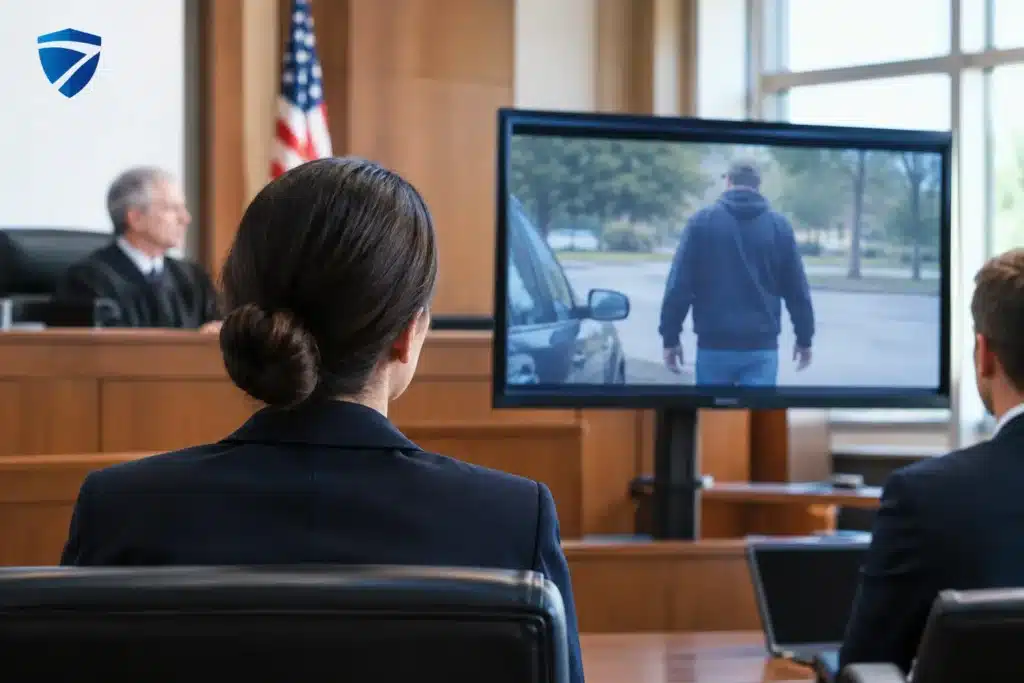
A juror may hear testimony about a difficult injury, a dangerous worksite, or a critical moment in a deposition and understand the words without fully grasping the reality. Well-produced legal video closes that gap. What makes courtroom video persuasive is not drama or visual polish for its own sake. It is the disciplined presentation of relevant evidence in a form the fact finder can see, hear, follow, and trust.
For trial teams, that distinction matters. A video that feels overly produced can invite skepticism. A video with poor audio, confusing structure, or unreliable playback can weaken even strong evidence. The most effective courtroom video is technically sound, procedurally appropriate, and tightly connected to the issues the court must decide.
What Makes Courtroom Video Persuasive in Practice
Persuasion begins with comprehension. If the judge, jury, mediator, or arbitrator has to strain to hear a witness or decipher what appears on screen, attention moves away from the evidence. Clear audio, stable images, readable exhibits, and intentional pacing allow the viewer to focus on substance.
This is especially significant when video stands in for a live experience. A recorded deposition may be the jury’s only opportunity to evaluate a witness’s demeanor. A day-in-the-life production may be the clearest way to show how an injury affects ordinary routines. A reconstruction animation or site video may help the fact finder understand physical relationships that are difficult to convey through testimony alone.
The video should answer a practical question: what does the viewer need to see or hear to understand this point? That question keeps production decisions tied to the case rather than to unnecessary visual effects.
Credibility Is the Foundation
A courtroom audience is alert to exaggeration. Persuasive legal video earns confidence by appearing accurate, balanced, and faithful to the record. That starts before a camera is turned on.
For deposition video, professional framing and clean audio preserve the witness’s testimony without calling attention to the production itself. The witness should be visible enough for the viewer to assess expressions and responses, while the record remains the focus. Consistent lighting, an appropriate background, and properly placed microphones may sound routine, but each detail affects whether the video feels dependable.
For documentary-style evidence, authenticity often carries more weight than dramatic presentation. In a day-in-the-life video, the objective is not to manufacture an emotional response. It is to document genuine limitations, treatment, assistance, and daily activities in a manner that accurately reflects the subject’s circumstances. The strongest moments are often ordinary ones: a spouse helping with a task, a careful transfer from bed to chair, a therapy appointment, or the extra time required for a familiar routine.
Credibility also depends on preserving context. An edited deposition designation must fairly reflect the testimony selected and comply with the court’s rulings. A reconstruction must be grounded in the available facts and qualified analysis. Video can clarify an argument, but it cannot repair unsupported assumptions.
Clarity Turns Complex Evidence Into Something Usable
Litigation often involves information that is hard to hold in memory: dates, measurements, sequences, medical records, contract language, multiple witnesses, or technical processes. Video is persuasive when it organizes that information without oversimplifying it.
A synchronized deposition is a good example. When spoken testimony is aligned with a searchable transcript, counsel can locate key passages quickly during preparation and present designated testimony with visual text support when appropriate. The format helps the legal team work efficiently while giving the courtroom audience another way to follow the record.
Visual clarity is equally important with demonstratives. An accident scene video should establish orientation before focusing on a disputed point. Viewers need to understand where the vehicles, people, equipment, entrances, or sightlines were located. A medical illustration must use understandable labels and a sequence that follows the testimony. If the visual moves faster than the explanation, it can create confusion instead of clarity.
Effective courtroom video also respects the limits of attention. A single clip should make a discernible point. A longer presentation should have a logical progression, with transitions that help the viewer understand why the next segment matters. The goal is not to show everything collected during discovery. It is to present the material necessary for the audience to evaluate the issue before it.
Human Detail Matters, but Restraint Matters More
Video can communicate human impact with an immediacy that documents and oral descriptions cannot always match. That does not mean every case calls for an emotional presentation. The right approach depends on the evidence, the forum, the rulings in the case, and the point counsel needs to establish.
In a personal injury matter, carefully documented daily limitations may provide useful context for medical testimony and damages evidence. In a commercial dispute, a concise video deposition excerpt may be more valuable than any documentary footage. In a liability case involving a physical location, a well-planned site video can show visibility, distance, access, or operational conditions more effectively than photographs viewed one at a time.
The trade-off is straightforward. Too little context leaves the fact finder with an abstract account. Too much material can feel repetitive or argumentative. Professional legal video production helps counsel find the appropriate level of detail while preserving a presentation that is respectful of the subject and suitable for court.
Technical Reliability Supports the Argument
A persuasive video must work when it is needed. This is not merely a production concern. It is a trial-preparation concern.
Courtroom playback may involve unfamiliar equipment, differing screen formats, remote participants, audio routing, or a last-minute change in the presentation environment. A file that plays properly on one computer is not automatically ready for a courtroom or hearing room. Format compatibility, audio levels, resolution, backup copies, and exhibit labeling should be addressed before the proceeding begins.
The same principle applies to remote and hybrid depositions. Witnesses may appear from another state, attorneys may be in different offices, and exhibits may need to be shared and marked in real time. Without experienced coordination, technical distractions can interrupt the examination and diminish the quality of the record. With proper preparation, the technology recedes and the testimony remains central.
Fast turnaround is also part of reliability. Designations change. Objections are resolved. A hearing is moved forward. Legal teams need a video partner who understands that a revised clip, a synchronized transcript, or a courtroom-ready deliverable may be required on a compressed schedule. The work must be completed quickly without compromising accuracy.
Editing Should Serve the Record, Not Compete With It
Editing is where legal video becomes especially useful and especially sensitive. Done properly, it removes dead time, organizes approved testimony, improves usability, and helps counsel present evidence efficiently. Done carelessly, it can distort meaning, create disputes, or undermine confidence in the presentation.
A strong editing process begins with the legal team’s direction and the governing requirements for the matter. Deposition clips should follow designations, objections, rulings, and any necessary counter-designations. The editor’s role is to execute the approved presentation precisely, not to reshape testimony into a new argument.
For non-deposition footage, editing should preserve an honest sequence and avoid manipulative choices. Music, dramatic transitions, stylized color treatments, and rapid cuts may be common in commercial video, but they can be counterproductive in litigation. Clean edits, legible titles where permitted, accurate captions, and consistent sound generally do more to support credibility.
This is why category-specific experience matters. A legal video professional understands that the deliverable is not simply a finished media file. It is a litigation tool that must fit into attorney workflow, comply with instructions, and perform under scrutiny.
Preparation Creates Persuasive Playback
The best time to solve a playback problem is before a juror enters the room. Trial teams should review courtroom video in its final format, confirm the order of clips and exhibits, and identify who will operate the presentation. If a video is being used during a remote proceeding, test the platform’s audio-sharing and screen-sharing settings rather than assuming they will function as expected.
It also helps to plan for the human side of presentation. Counsel should know the start and end point of each clip, how it connects to the next question or exhibit, and what the fact finder should take from it. A video is most effective when it is integrated into the examination or argument, not treated as an interruption.
For Seattle-area legal teams managing time-sensitive depositions, trial preparation, and evidentiary presentations, Royal Video Productions brings specialized legal-video experience to that preparation. The objective is straightforward: deliver accurate, courtroom-ready video that lets the evidence speak clearly.
The most persuasive courtroom video rarely announces itself as persuasive. It gives the fact finder a clear view of the record, protects the credibility of the evidence, and works without distraction when the case reaches its critical moment.