
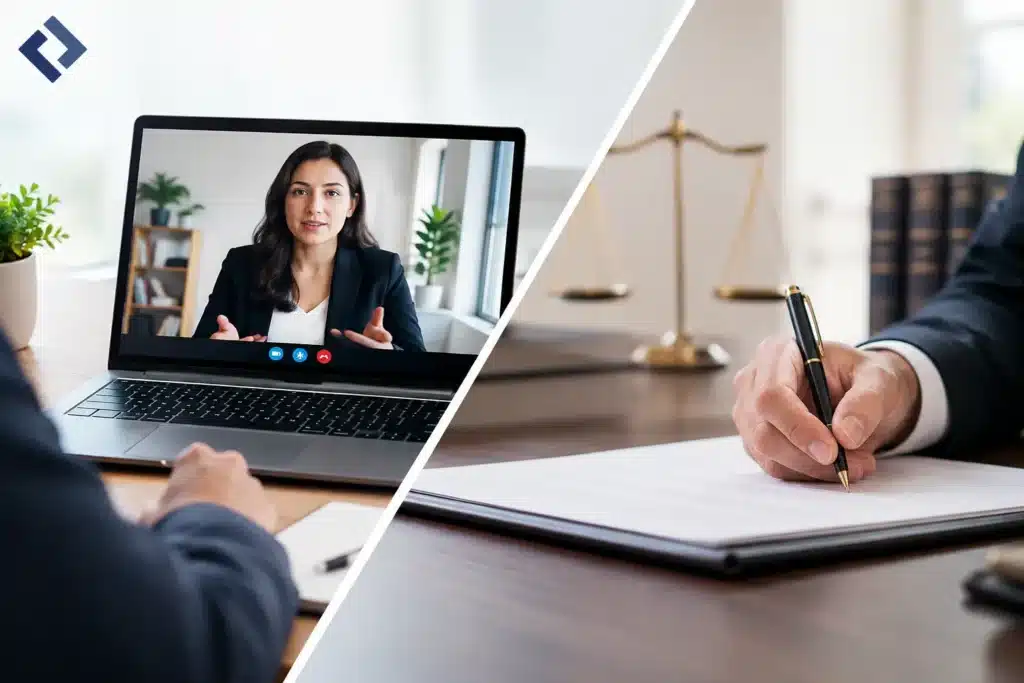
A witness located three states away can be examined without anyone leaving the office. That convenience does not mean a remote deposition and a written deposition accomplish the same thing. In the remote deposition versus written deposition decision, the central question is not simply which option is faster. It is whether your case needs live examination, a witness record that can be played persuasively later, or a tightly controlled exchange of written questions.
For litigators, the distinction affects more than scheduling. It can shape how much information the witness provides, how effectively counsel can test credibility, what objections can be made in real time, and whether the resulting record supports mediation or trial preparation. The right format depends on the witness, the disputed facts, the governing rules, and the purpose of the examination.
The Core Difference Between the Two Formats
A remote deposition is ordinarily an oral deposition conducted through a secure videoconference platform. Counsel question the witness live, a court reporter creates the official transcript, and a legal videographer may record the proceeding. Participants can be in different locations, but the examination remains live and interactive.
A written deposition, more commonly called a deposition upon written questions, uses questions prepared in advance. The questions are served according to the applicable rules, objections may be submitted, and an authorized officer asks the approved questions of the witness. Counsel do not have the same opportunity to hear an unexpected answer and immediately follow up.
That difference is decisive. Remote testimony changes the location and technology of an oral deposition. Written questions change the examination itself. A remote deposition can preserve the pace, pressure, and responsiveness of live questioning. Written questions offer structure, but generally sacrifice the ability to pursue new information as it appears.
When a Remote Deposition Is the Better Litigation Tool
Remote depositions are often the practical choice when counsel needs to evaluate a witness, develop testimony, or create a record for later use. The witness may be across the country, have limited mobility, or face a schedule that makes in-person attendance inefficient. In those circumstances, remote access can reduce coordination burdens while maintaining live examination.
The live format is particularly valuable when demeanor matters. Pauses, uncertainty, confidence, and the way a witness handles documents can all affect case assessment. A transcript captures words. Properly produced legal video can also preserve how those words were delivered, which may be useful in mediation, impeachment preparation, or trial presentation when the testimony is admissible and designated for use.
Remote questioning also allows counsel to follow the evidence. If a witness identifies another person, changes a timeline, or gives a qualified answer, examining counsel can ask the next question immediately. That flexibility is often essential in personal injury, liability, employment, construction, and commercial disputes, where a seemingly minor answer may open a new line of inquiry.
A professionally managed remote proceeding helps keep that flexibility from becoming disorder. The legal team should know who is present, how exhibits will be introduced, whether the witness has a reliable connection and appropriate camera position, and how the official record will be protected. A court reporter and experienced legal video professional can coordinate the technical elements without asking counsel to become technical support during examination.
Video Adds Value When the Witness Matters
Not every remote deposition needs video. If the goal is limited fact confirmation or discovery on a narrow issue, a transcript may be sufficient. But when credibility, condition, damages, causation, or a key admission is at stake, video can give the legal team a more complete record.
The quality of that record matters. Poor framing, inconsistent audio, dropped connections, and confusing exhibit handling can distract from testimony and create avoidable friction. For proceedings that may be used beyond discovery, the production should be handled with the same care as any other litigation-ready asset. This includes clear audio, stable video, accurate identification of speakers, dependable exhibit workflow, and properly delivered files for transcript synchronization or editing when needed.
When Written Questions May Make Sense
Written depositions can be appropriate when the needed testimony is narrow, factual, and unlikely to require follow-up. They may be useful for authenticating a record, confirming custodial information, obtaining routine background facts, or examining a witness whose testimony is expected to be straightforward and noncontroversial.
They can also help when expense and logistics must be tightly constrained, although counsel should weigh the apparent efficiency against the risk of an incomplete record. A carefully drafted set of questions may obtain a needed answer. It may also produce an answer that is vague, qualified, or surprising, with no immediate opportunity to clarify what the witness meant.
Written questions are therefore less effective when facts are disputed, the witness may be evasive, documents require explanation, or counsel needs to probe the basis for opinions and recollections. They are not a substitute for cross-examination. They are a procedural tool best used when the expected value of live follow-up is low.
Remote Deposition Versus Written Deposition: Strategic Trade-Offs
The choice should begin with the purpose of the testimony. If your team needs discovery only, identify the exact information that must be established. If the witness is central to a dispositive motion, mediation position, or trial presentation, consider what may be lost without live examination and video.
A remote oral deposition typically offers greater evidentiary development because counsel can respond to the witness in real time. It also allows opposing counsel to make objections as questions are asked, subject to the rules and agreements governing the proceeding. The trade-off is that it requires more coordination: participant notices, platform access, exhibit protocols, connection testing, witness instructions, and a plan for technical interruptions.
A written deposition reduces some scheduling complexity. Yet it places much more weight on the initial drafting of the questions. Every question must anticipate the answers, objections, and areas that might otherwise be explored through follow-up. If the testimony becomes important later, the saved time at the outset may be outweighed by the lack of a developed record.
The governing procedural rules should always guide the decision. Federal practice and Washington state practice have specific requirements that can affect notice, stipulations, officer administration, remote means, objections, and use of testimony. Court orders and local practices may add another layer. Confirm the applicable requirements before selecting a format, especially when testimony could be offered at a hearing or trial.
Questions to Ask Before You Notice the Deposition
Before choosing a format, the litigation team should consider five practical issues:
- Does the witness need to be tested through live follow-up questions?
- Will demeanor or the witness’s physical presentation matter to case evaluation?
- Are exhibits likely to require detailed explanation or comparison?
- Is the testimony intended for discovery, motion practice, mediation, or trial use?
- Can the team establish a reliable technical and recording process for a remote proceeding?
If the first four answers point toward a fuller examination, a remote oral deposition is usually the stronger choice. If the testimony is limited and procedural, written questions may be sufficient. The answer is not always about convenience. It is about preserving the information and presentation value the case will require later.
Preparing a Remote Deposition That Holds Up
Remote proceedings work best when preparation begins before the notice goes out. Counsel should determine whether the deposition will be video recorded, identify the exhibit method, and make sure the witness has a quiet location, dependable internet access, and a device that provides a clear camera view. A brief technology check can prevent lost time on the record.
Instructions should also address witness conduct. The witness should understand when to pause for objections, how documents will be displayed, and that off-camera communications or unsupervised messaging can create serious concerns. If an interpreter, guardian, support person, or corporate representative will attend, clarify that person’s role in advance.
For recorded proceedings, use a legal video provider that understands deposition protocol rather than a general event-production workflow. The goal is a clean, defensible record that can be delivered promptly and, where appropriate, synchronized to the certified transcript. Royal Video Productions supports remote and hybrid legal video work with the production discipline and responsive coordination litigation teams need when deadlines are close.
Choose the Format That Protects the Record
Written questions are useful when the testimony is confined and predictable. A remote deposition is usually the more capable tool when facts are contested, documents need context, or a witness’s credibility may influence the outcome. The most effective choice is the one that gives counsel the record they will wish they had when the case becomes more demanding.